
POWDERS · INTERFACES · FORMULATION
Yes, We Sell Powders. No, That's Not the Whole Formula.
The same titanium dioxide name can hide very different formulation behaviour. Five powder grades and a phase-inversion system show why we want the conversation to go beyond the quotation.
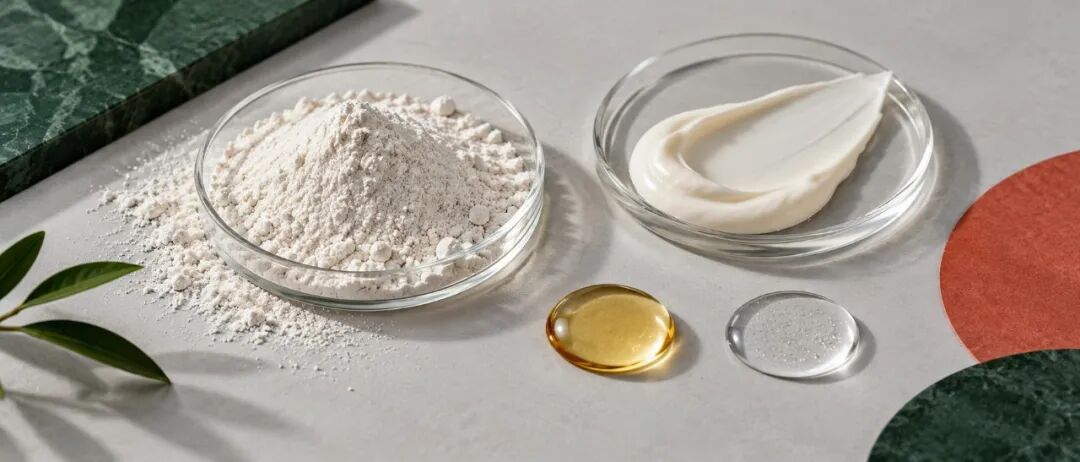
A fair question. Just not the last one.
“What is the price per kilo?” It is one of the questions we hear most often. Of course price matters. But the value of a powder also depends on what you can make with it.
Change the surface-treated grade, even when both materials are called titanium dioxide, and the grinding behaviour, viscosity or storage behaviour can change. We want to help answer the next question: what changed, and how do we check it?
A fine dispersion is not the same as a stable emulsion
Wetting, dispersion and interfacial stabilisation are different jobs. A smooth drawdown does not tell you whether the powder will settle. An even dispersion does not show that the particles can stabilise an oil–water interface.
Before we describe a powder as doing more, we need to be clear about which job it is doing.
THREE SEPARATE JOBS
Wetting
Does the medium spread over the powder?
Dispersion
Can the agglomerates be broken up?
Interface
Can the particles help stabilise droplets?
Pickering and Janus are not two names for an upgrade
Pickering describes a mechanism: solid particles adsorb at an oil–water interface and help stabilise droplets. Janus describes a structure: different regions of the same particle have different properties.
The distinction matters. One study used starch microparticles as co-stabilisers within an established emulsion platform. Another used deliberately engineered titania-cored Janus multipods. Neither is a reason to assume that any surface-treated commercial powder will behave in the same way. [1, 2]
STRUCTURE IS NOT A MECHANISM
Surface treatment
Changes the particle’s surface composition.
Janus
Different regions on one particle.
Pickering
Particles stabilise an oil–water interface.
PI-100F gives us something concrete to investigate
PI-100F is one of GreenDee’s innovative raw materials. It combines silica with emulsifying components in a composite phase-inversion system. The design ambition is straightforward: a water-light feel while spreading, followed by a film that stays in place.
Its supplier describes the proposed route as “non-conventional Pickering”, involving particles and water-loss-driven phase inversion. Because the composition also includes PEG-100 stearate and other emulsifying components, particle–emulsifier cooperation is the more useful description. This is not a surfactant-free particle-only system, and it is not a claim of Janus structure. [4]
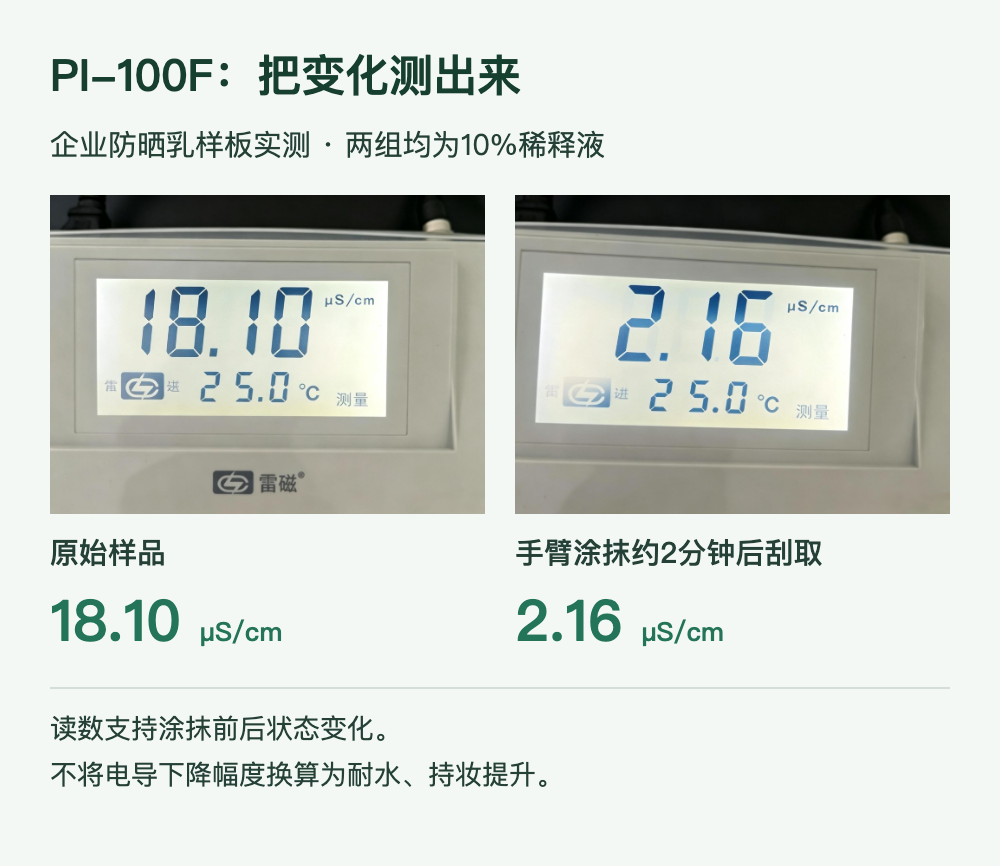
There is a measurement behind the discussion. In a company sunscreen prototype, the original sample and material scraped from the forearm after approximately two minutes were each prepared as a 10% dilution. Conductivity readings were 18.10 and 2.16 µS/cm, respectively. The readings support a change in the sampled state; they do not quantify an improvement in water resistance or wear. [5]
COMPANY PROTOTYPE · CONDUCTIVITY
Both prepared as 10% dilutions. The second sample was scraped from the forearm after approximately 2 minutes.
A concept becomes useful when there is a formula to try
The September application materials set out three starting formulations: a rich cream, a foundation cream and a phase-inversion sunscreen lotion. That makes the discussion practical: there is something to make, feel and test.
The foundation and sunscreen prototypes also contain AquaFuse PG. Their finished-formula behaviour cannot be assigned to PI-100F alone. [7]
THREE FORMULATION STARTING POINTS
Rich cream
PI-100F in the reference formulation
Foundation cream
Also contains 3% AquaFuse PG
Phase-inversion sunscreen lotion
Also contains 3% AquaFuse PG
Five powders, one base, a useful difference
The five samples in the published comparison are CR-50TMS, CR-50ASM, TR-586AS, CR-50AS and TR-586AS-LL-MQ-ITT.
In the same cushion-foundation base, with each commercial powder used at 10%, the TMS grade gave the lowest readings on both measurements and the complex-treated grade the highest. That is a useful formulation difference to investigate, not a league table of finished-product performance. [3]
FIVE GRADES · SAME CUSHION BASE
Two viscosity readings
First readingRepeat reading
CR-50TMS
CR-50ASM
TR-586AS
CR-50AS*
TR-586AS-LL-MQ-ITT
The next questions belong in the formula
The original article proposed a follow-up comparison of dispersion, powder loss on contact with oil, rub transfer and darkening over time. These are the next questions, not new results reported here.
Once there are controlled comparisons, we can separate what comes from the powder from what depends on the whole formula. We are less interested in naming a winner than in finding the right material for the job.
PROPOSED IN THE ORIGINAL ARTICLE
- Change the oil: does the powder still disperse?
- On contact with oil: is powder lost more easily?
- After rubbing: how much remains?
- As colour darkens: what comes from time, and what comes from oil?
A good raw material needs a place in the formula
Not every powder needs a new technical label. Connecting material identity, behaviour at the interface and finished-formula performance is more useful.
We will still answer the price question. We would also like to know what you are trying to make.
TAKE IT TO THE LAB
Tell us what you are trying to make.
Ask about product information, reference formulations or sample support. Share your application, company and location so the right team can follow up.
Sources & reading
[1] Spena et al. · RSC Advances, 2026
[2] Kwon et al. · Small, 2025 (online 2024)
[3] Company powder comparison records, reproduced in the original article.
[4, 5, 7] PI-100F product documentation, conductivity test and September application materials. Company measurements and reference formulations are distinct from the papers above.