
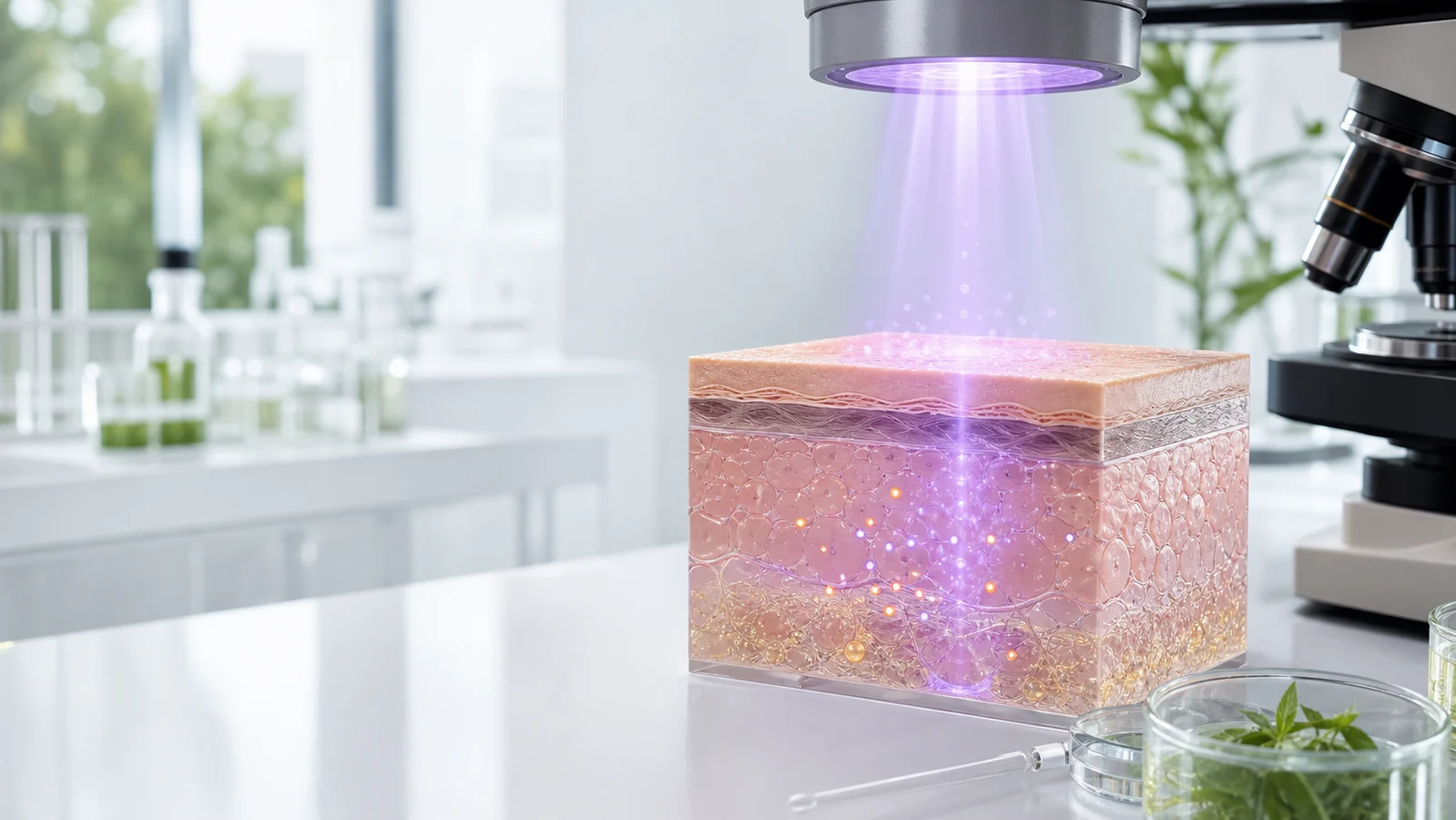
This editorial examines the link between rhamnolipid chemodiversity and high-concentration rheology, contrasting optical attenuation with biological inhibition for visible light-induced pigmentation. It defines evidence boundaries and proposes validation experiments to assess formulation transfer and clinical equivalence without asserting current efficacy.
Chemodiversity and Rheological Transitions
Rhamnolipids are complex mixtures of mono- and di-rhamnolipid isomers, with commercial samples showing a 60% di-rhamnolipid and 70% di-tail distribution. This chemical heterogeneity dictates self-assembly behavior, where increasing concentration shifts the system from Newtonian to non-Newtonian fluid. At 70-80wt%, the formation of aggregates and yield stress indicates a transition to solid-like behavior under low shear, providing a rheological basis for highly concentrated, low-water systems.
The emergence of yield stress at high concentrations is not universal and depends heavily on specific isomer ratios and free fatty acid content. While this structural network supports the potential for stable, concentrated formulations, it does not confirm functional performance in photoprotection. The rheological data establishes a physical boundary for formulation design but requires further investigation to link these macroscopic flow properties to microscopic stability under light exposure.
Impurities and Self-Assembly Stability
Analytical profiling reveals significant free fatty acids, particularly C10-3-hydroxy fatty acids, which act as co-surfactants. These components alter micellar packing parameters and critical micelle concentration, directly influencing the rheological threshold. The presence of unsaturated fatty acids introduces potential oxidation pathways, which may compromise long-term stability. These minor components exert a non-linear effect on self-assembly, making them critical variables for formulation reproducibility and process control.
The interaction between free fatty acids and the rhamnolipid matrix creates a complex stability landscape that cannot be extrapolated from pure compound data. Oxidative degradation of unsaturated tails may shift the rheological profile over time, affecting the structural integrity of the network. Understanding these impurity-driven dynamics is essential for predicting shelf-life and ensuring consistent flow behavior, yet current data lacks direct correlation with microstructural changes such as those observed via small-angle X-ray scattering.
Visible Light Mechanisms and Strategy Divergence
High-energy visible light (400-500nm) stimulates melanogenesis primarily through Opsin 3 activation in melanocytes, a mechanism particularly pronounced in darker skin types. Recent findings suggest that blue and green light can also trigger melanin production in lighter skin, challenging the traditional focus on UV radiation alone. This broadens the spectral range requiring management and highlights that visible light-induced pigmentation is not a uniform phenomenon across all skin types, necessitating a more nuanced approach to photoprotection.
Two primary strategies address this issue: optical attenuation using pigments like iron oxides, and biological inhibition using active ingredients that block melanin synthesis. Optical filters directly reduce photon flux but often suffer from poor sensory acceptance due to color mismatch and residue. Biological agents, such as tyrosinase inhibitors, offer a non-tinted alternative but require strong UVA1 protection to be effective. The choice between these strategies involves a trade-off between direct light reduction and indirect pathway inhibition, with no clear consensus on their relative superiority.
Validation Requirements and Evidence Limits
To bridge the gap between rheological potential and clinical application, specific validation experiments are required. First, 80wt% rhamnolipid systems must be tested for photostability under HEVL, measuring changes in 400-700nm transmittance and color difference (ΔE) to detect degradation. Second, a randomized controlled trial should compare a 'strong UVA1 + biological inhibitor' regimen against a 'tinted HEVL filter' in post-inflammatory hyperpigmentation patients, using melanin index and compliance scores as endpoints. Third, the impact of free fatty acid content on oxidative stability should be quantified by monitoring peroxide values and rheological shifts under accelerated aging conditions.
Current evidence does not support claims of efficacy, safety, or regulatory status for rhamnolipid-based visible light protection. The rheological data is derived from a single commercial source, limiting generalizability to other fermentation or purification methods. Furthermore, the equivalence of optical and biological strategies is based on review-level data and small-scale studies, lacking large, multi-center randomized controlled trials. Sensory acceptance remains a subjective variable, and the interaction between rhamnolipid carriers and active ingredients is not yet fully characterized, preventing definitive formulation recommendations.
Editorial and use boundary
Evidence is limited to rheological characterization of a single commercial rhamnolipid sample and review-level data on visible light pigmentation mechanisms. No clinical efficacy, safety, or regulatory claims are established for specific formulations or ingredients.