
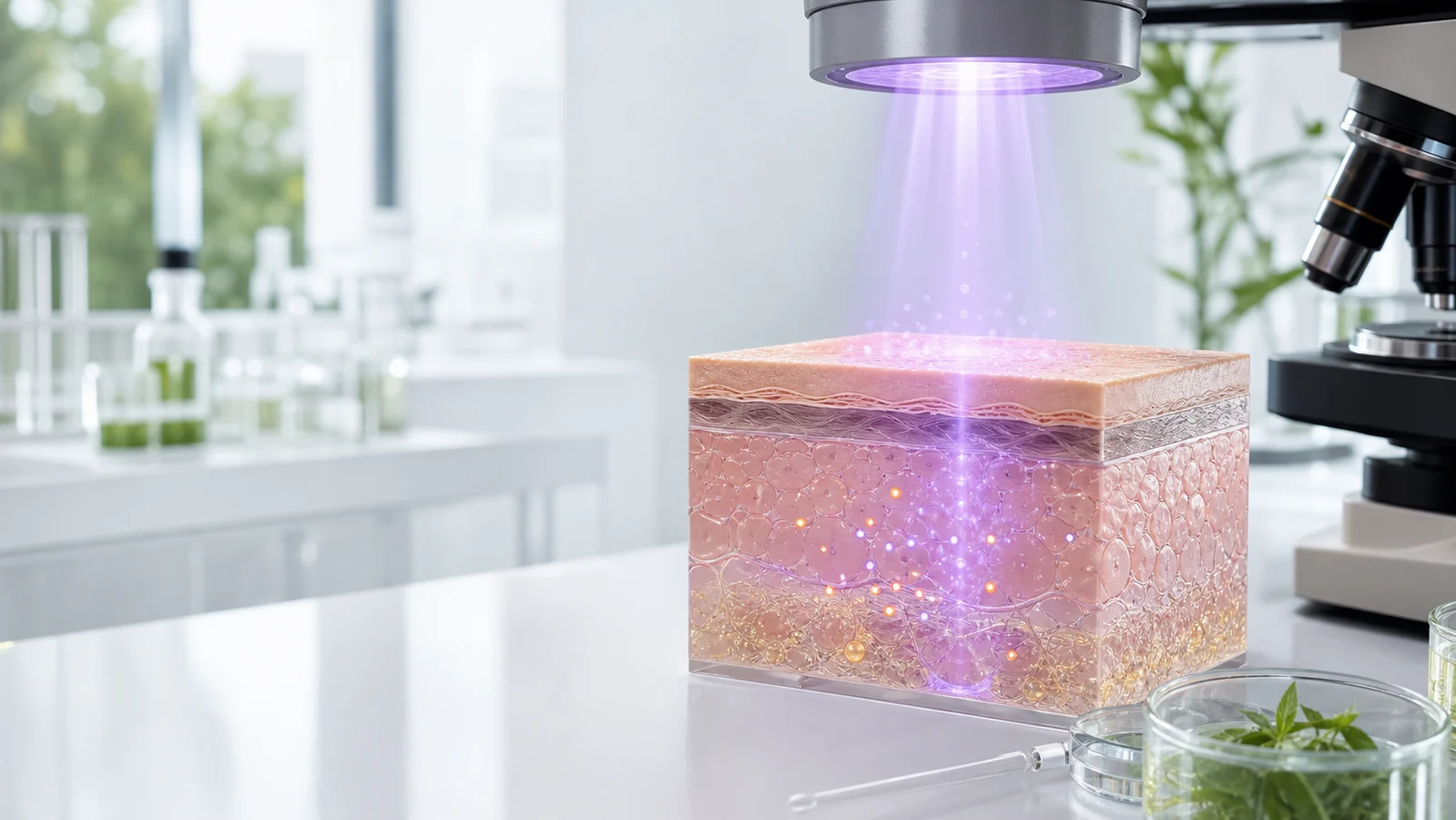
This editorial distills evidence on HEVL and UVA1 synergistic damage, outlining validation experiments for iron oxide and antioxidant formulations. It defines evidence boundaries and formulation transfer conditions without asserting current efficacy or safety claims.
Mechanistic Synergy of HEVL and UVA1
High-energy visible light and UVA1 radiation interact through specific photoreceptors to drive melanogenesis and oxidative stress. The mechanism involves the activation of Opsin 3, which stimulates tyrosinase activity, particularly in darker skin types. This pathway is distinct from but synergistic with UVA1-induced damage, creating a compounded effect on pigmentation and dermal integrity.
The biological impact extends to mitochondrial dysfunction, where UVA1 exposure leads to large-scale mtDNA deletions. This mitochondrial damage correlates with the upregulation of MMP-1, a key enzyme in collagen degradation. Understanding this dual pathway is critical for designing interventions that address both pigmentary changes and structural dermal aging simultaneously.
Formulation Transfer and Material Constraints
Translating these mechanisms into formulations requires balancing physical filtering with chemical antioxidant capacity. Iron oxides serve as physical filters for HEVL, but their chromatic properties must be carefully matched to ensure sensory acceptance across diverse skin tones. This constraint limits their universal application and necessitates precise colorimetric calibration during development.
Plant-derived antioxidants, such as those from Coffea arabica, offer potential chemical protection against ROS. However, their integration depends on stability and bioavailability within the final matrix. The formulation must ensure that these components remain active under storage conditions while maintaining the physical integrity of the mineral filters.
Validation Experiments and Endpoints
To verify the protective efficacy of combined strategies, a co-culture model of melanocytes and fibroblasts is proposed. This experiment compares groups exposed to HEVL and UVA1 with and without iron oxide and organic UV filters. Endpoints include tyrosinase activity, MMP-1 expression, and light transmittance, with failure defined by a lack of significant improvement over organic filters alone.
A second validation focuses on mitochondrial protection using human fibroblasts subjected to UVA1 stress. This assay measures mitochondrial membrane potential and mtDNA deletion ratios in the presence of antioxidant formulations. Success is indicated by a statistically significant reduction in mtDNA damage and improved membrane potential compared to untreated controls.
Evidence Boundaries and Limitations
Current evidence does not support definitive claims regarding the long-term safety or standalone efficacy of these ingredients. The synergistic effects of HEVL and UVA1 may vary significantly among individuals, meaning that standardized protocols may not capture all biological responses. Additionally, the boundary between intrinsic and extrinsic aging remains blurred in existing literature.
Limitations include the lack of standardized extraction methods for plant actives and limited clinical data covering all skin types. The antioxidant capacity of specific botanicals may be insufficient to counteract photodamage without synergistic partners. Therefore, conclusions about finished-product performance remain provisional pending further clinical validation.
Editorial and use boundary
Evidence is limited to in vitro and specific clinical contexts; no current efficacy, safety, or regulatory claims are made.