
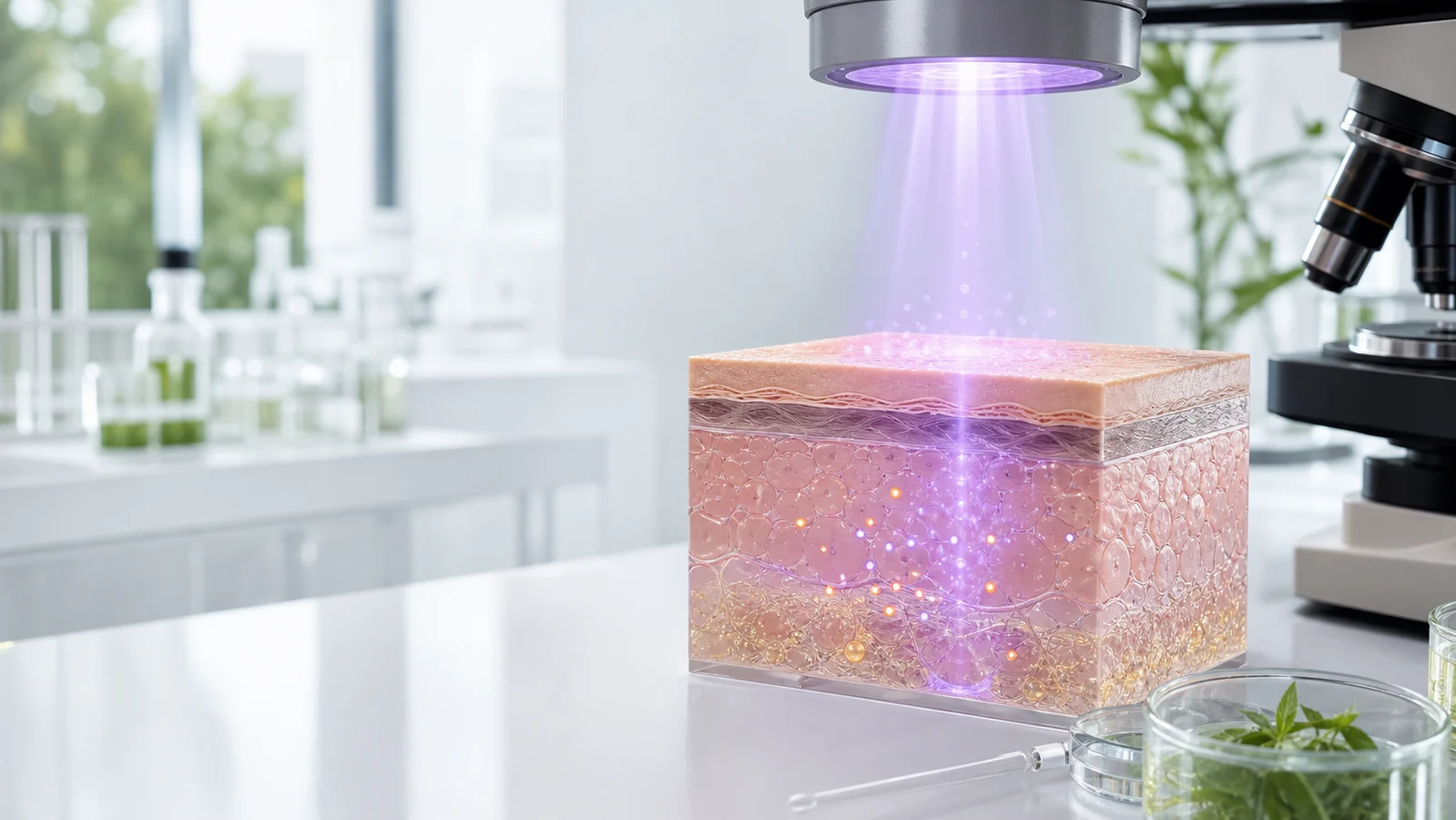
This editorial examines the self-assembly of Boc-L-Dopa(Bn)2-OH at pH 5 with surfactants. It distinguishes direct rheological data from secondary photoprotection reviews, outlining specific experimental needs to validate optical and biological effects in complex cosmetic systems.
Evidence Hierarchy and Scientific Question
The core inquiry focuses on how Boc-L-Dopa(Bn)2-OH forms gel networks with anionic surfactants at pH 5, specifically regarding visible light scattering and UVA1 interaction. The primary evidence comes from direct rheological and microscopic observations of gel formation, which establish the physical basis for the material's behavior. This direct data is distinct from secondary literature that discusses general photoprotection mechanisms without specific reference to this dopa derivative system.
Secondary sources provide context on UVA1 damage and visible light effects on pigmentation but do not directly test the dopa gel. Therefore, the scientific question remains whether the physical network properties observed in primary data can be extrapolated to explain biological outcomes like photoprotection or pigment modulation. This distinction is critical for avoiding over-interpretation of the available evidence.
Physicochemical Mechanism and Network Formation
At pH 5, the carboxyl groups of Boc-L-Dopa(Bn)2-OH protonate, reducing electrostatic repulsion and facilitating self-assembly into a fibrous network. The stability of this gel depends heavily on the specific surfactant used; N-substituted amino acid surfactants with pKa values near 5 show strong synergy, while sulfonate or sulfate surfactants rely more on the gelator's intrinsic properties due to their low pKa.
The addition of CAPB reduces gel strength but maintains self-supporting structure, indicating limited interference with the fibrous network. This suggests that while ionic strength and surfactant type modulate the network's mechanical integrity, the fundamental self-assembly mechanism remains robust under these specific conditions. The resulting fiber dimensions are large enough to scatter visible light, causing a transition from transparency to opacity.
Biological Inferences and Conflicting Data
Secondary literature suggests that UVA1 and visible light influence skin aging and pigmentation through mitochondrial DNA damage and opsin 3 activation. The dopa gel's aromatic rings may absorb UVA1, and its fibrous structure may scatter visible light, potentially mitigating these effects. However, these biological links are inferential and lack direct experimental confirmation within the dopa gel system itself.
Conflicting evidence exists regarding polyphenolic compounds, which may either inhibit or enhance melanogenesis depending on the context. Since the dopa derivative contains phenolic structures, its effect on pigmentation could be bidirectional. Furthermore, collagen-related mechanisms discussed in other reviews are not directly linked to the dopa gel's action, highlighting the need to isolate specific pathways from general skin health concepts.
Formulation Transfer and Validation Experiments
Translating these findings to real-world formulations requires addressing pH fluctuations, surfactant ratios, and the presence of excipients like preservatives. The current data is limited to specific concentrations and pH 5, so stability under temperature cycling and long-term storage remains unverified. These factors could significantly alter the gel's rheological properties and optical characteristics in a finished product.
Three key validation experiments are necessary: first, testing pH stability across a range of 4 to 6 to determine the gel's operational window; second, comparing different surfactant types to isolate their impact on network strength and light scattering; and third, quantifying UVA1 absorption and melanocyte activity to confirm or refute the proposed biological effects. These experiments will define the true boundaries of the material's performance.
Editorial and use boundary
Direct rheological data from S1 is primary; photoprotection and pigmentation links are secondary inferences from S2-S4 requiring independent biological validation.